


#global teams
#tech teams
#distributed teams
Beyond The Code
Available on


.svg)


Are we entering an era where AI applicants are filtered by AI recruiters, with zero human interaction?
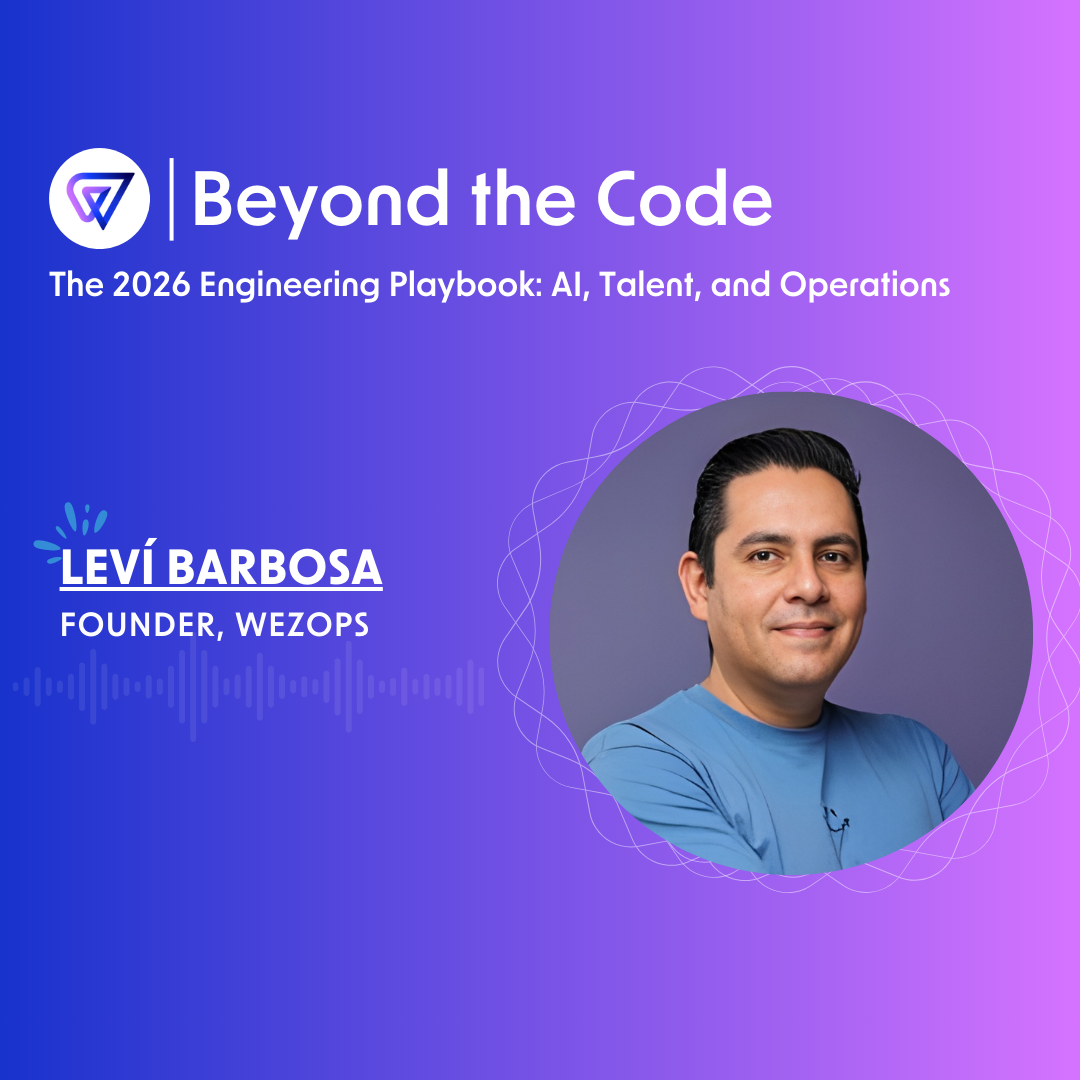
In this episode of Beyond the Code, Maulik Sailor and Anjon Roy sit down with Leví Barbosa, Founder of WezOps, to dissect the rapidly changing landscape of Engineering Leadership and Talent Operations in 2026.
Leví brings 18+ years of experience in building custom operational stacks for scaling tech companies. Together, they explore the "race to the bottom" in AI recruiting, why Engineering Managers must evolve into "Orchestrators," and how companies are now using AI usage metrics for performance reviews.
What we cover:
Maulik Sailor (00:12)
All right. ⁓ Our stream should be live on LinkedIn. Let's wait for a few seconds, a minute for people to sign up on or join LinkedIn.
Sometimes with this reverse hide, normally it does go live on LinkedIn well, but sometimes it just messes up the link. So yeah, I hope it's all good.
Right. ⁓
If you're good, I think we are good to kick off. People will join once they get notified through LinkedIn and through Luma. The event is slow, people will join. But I think if you both are good, then I'm good to kick off today's session. All right, folks, welcome to the new episode of Notchup Podcast Beyond the Code. This is the first one for 2026 that we are doing.
We had about 12 episodes in 2025. That was the first year we started doing podcasts. We had some incredible guests. We touched upon a lot of topics when it comes to building high performing engineering teams. We had guests talking about the innovation mindset, the innovation culture. had guests talking about ⁓ HR in general and attracting talent in specific.
We also had engineering leaders talking about nurturing the ⁓ data engineering departments, the talent within them, how they really go about doing their things, how things are changing ⁓ with all these agent-a-kin AI tools and platform that are being continuously developed. I think the way we run our engineering operations has been changing really fast. There are two sides to the equation. One is the engineering output as in the
and the software and the platforms that you build, that's being changed on how you're building that. But also the other side of the equation, like the teams, the departments, the operations, that's also is changing. Like what kind of team structures do you have? What kind of roles and responsibilities do you have? How do people work together and so on? So I think all of that is currently in the flux, right? And whatever maybe I think is happening today,
Possibly in two weeks time may be changing right? So, know everything we're gonna talk about May not hold true for too long, right? Anyways without too much delay today. I have two guests as you can see on the on the podcast ⁓ Let me first introduce Anjon So until now I have been mainly a solo founder for notch up and I've been trading and experimenting
on how you would go about building and running a software engineering department. And then in the summer of 2025, I and Anjon met through a startup founders community. We started talking about the stuff that I've been looking into. He had prior experiences within that. And then we decided to work together on the problem statement. So Anjon.
He recently joined me as my co-founder ⁓ for Notchup. Anjon why don't you introduce yourself quickly?
Anjon (04:03)
Thanks, Malik, and nice to meet everyone here. Anjon Roy, very happy to be here, really excited to kick off 2026 with our first ⁓ Notch Up podcast, live podcast, and my personal first one. So pleasure to meet everyone, and thank you all for joining us, everyone live or everyone who will be watching this on the recording after it's released.
Maulik Sailor (04:26)
Thanks a lot, ⁓ And the first guest for 2026 is none other than Levi. And we had ⁓ an episode recorded with him last year, and we talked a lot about talent, talent operations, building the culture of innovation, performance, efficiency, and so on. And we touched upon a lot of ⁓ points during that. But I felt that there was still more for us to talk and connect on.
Right. So we reached out to Levi. Sorry, I keep mispronouncing your name. It's Levi, ⁓ Levi, sorry. I get it wrong, right? It's Levi, right? So, you know, I thought we need to reach out back to Levi and get more of his insights, especially given the kind of work he does with the growing tech companies, particularly in the U.S. ⁓ And I thought maybe
Leví Barbosa (05:02)
Yeah.
Maulik Sailor (05:22)
It would be a great start for the new year for us to have Levy again as our guest. ⁓ Just for a quick reminder for the people who have not seen the previous episode, ⁓ Levy, please let us introduce ourselves quickly about the work, your background and the work you do.
Leví Barbosa (05:39)
Yeah, thank you. Yeah, so I also founded a WeZops. This is a consulting firm where I work on specializing in talent operations and now HR operations too. So helping companies ⁓ with their struggle systems, data, you know, like all that. And I have like over 18 years now of experiencing many, many different HR areas. ⁓
around 10 years working in other areas, know, projects on the side that match the same skills as we need in HR, finance, marketing, purchasing now, you know, but yeah.
Maulik Sailor (06:24)
Yeah, that's great, Levi. Great to have you as a guest again this year. And today, we're going to mainly talk about the way engineering tech departments are being built and scaled, right? And apologies for the rest of the folks who may be listening. You know, we generally talk about engineering department because I think that's our background. That's what we have been incredibly focused on.
Leví Barbosa (06:29)
Yes, thank you.
Maulik Sailor (06:53)
And I'm pretty sure what we talk for this particular department, a lot of that will also be applicable to the rest of the departments. But generally, we're going to talk about attracting the talent, what's changed, what are the things employees are looking for, what are the changes in the way you go about attracting and nurturing your talent, some systems, possibly some controls.
news in the industry and so on. So we're going to cover all of those topics. But let's start with the first question. Anjan, think you have a lot of questions that maybe you want to start with. Why don't you start with your first ask?
Anjon (07:38)
Thank you. Thank you, Malik. Levi, as this is all the talk and the hype and excitement around AI, and one general trend we're seeing, or at least a ⁓ narrative that seems certainly very credible, that AI is deflating the cost of intelligence. As a talent ops leader focused on knowledge workers and knowledge industries, and our focus on tech in particular,
which is clearly a knowledge industry and a core part of it. What are some of the trends that you're seeing in talent and people operations from this impact of AI? have certain trends accelerated? ⁓ Maybe they were trending harder a year ago, and now they decelerate a little bit. So what are the trends you're seeing as well as the changes of those trends themselves? Thank you.
Leví Barbosa (08:37)
Yeah, that's a great question. think last year we saw a lot about a lot of new sourcing tools, a couple of scheduling tools, but nothing for onboarding. Well, a couple of others, but I think a lot of the mind circle that I was involved, they were speaking a lot about top of the funnel, how we resolve. ⁓
We are getting 10,000 candidates for each job post that we have. How do we check all of them or at least half of them? That was a lot of what I saw last year. And a lot of the recruiters and talent teams, they were really focused on resolving that. Not like how do we spend less time on the top of the funnel and then we move forward with the other ⁓ stages of the process.
I think this year I have not seen a lot of news. I think what I heard more is about AI screening. think that was the first thing I saw a couple of weeks ago. It's been really interesting that, for example, we saw companies acquiring other companies to then grow the services that they offer.
I don't know if you have heard about Humily. They acquired three companies last year now. They are integrating more and more things into their systems and then expanding that. users can have a full suite of services with them. And they were specifically focused on AI screening. They had a chatbot. They then added sourcing, a specific
things in their system and then now more and more functions for scheduling and other things. So, I don't know, also the trend is that, not like companies acquiring more and more other tiny companies to then enhance their products and make them like a full suite of tools. You know, that's one thing. But on this other thing, the AI screen, you know, I...
I don't know if that's the right path, but I've seen a couple of companies telling, yeah, this year is going to explode, AI screening. We are going to screen 10,000 candidates, all the candidates that you receive in your applications, and then we will match the best for you.
I'm also thinking that...
Maulik Sailor (11:19)
I, sorry, I wanna pause
you there, right? I mean, attracting the top of the funnel, right? Getting the pool of applicant and then filtering them out. And certainly AI agentic tools have been like, you know, one of the data that has really exploded in this one, right? I think YC also funded a lot of startups in this space. But I always kind of believe that this is probably...
like an AI versus AI game and I've raised to the bottom in my view, right? And I could be wrong, but at least what I think is ⁓ there are AI-enabled, know, ATS, application tracking systems and job-posting platforms, which effectively post a lot of jobs and do the initial screening of the candidates. And then you have the AI...
CV generators and application tools. So candidates are also utilizing similar tools to basically apply to a lot of jobs that they probably have no clue about, like what is the team, what is the company. And then they are applying, trying to be the perfect candidate. And on the other side, you have tools which are kind of eliminating maybe two perfect candidates. So what's your view there? And again, like,
What would you recommend a possible or potential hiring manager ⁓ to look out for? How can they make sure that they are getting in front of the right talent and vice versa? How can a talent make sure that they getting in front of the right hiring manager?
Leví Barbosa (13:04)
Yes, I think that specific topic is something I discussed actually during this and last week with a couple of friends. We were discussing a lot like, we are seeing this from maybe a year and a half, And what we actually mentioned in our previous podcast, one AI is talking to the other AI and no human is in there. Candids create resumes, applying with AI.
And then on the other hand, recruiters, they score candidates using AI and then choose the top 10 shortlist with the hiring manager. then they actually don't even view candidates anymore. Like they are just passing to make the process more efficient or fast, you know, like that, because at the end, goal of recruiters is higher. Not like that is the end goal. And I think this year, like
What we should start thinking instead of maybe going with the AI screening and scaling and all these things is more on how we rethink the way we put against humans into this. Because yeah, it's crazy that I can create the perfect resume. I can get two, three interviews and then being hired, you know? I can also put my phone here.
read responses while I'm on an interview. I've seen that a lot. And then hiring managers, are like, wow, this guy is incredible, no? And then the first two, three months, we are seeing results that they didn't expect. I think that is ⁓ what we should start thinking, knowing how we put humans again back into the process because...
AI is talking with AI is not nobody else is it's insane what do think about that
Maulik Sailor (15:05)
Yeah. Yeah, I mean, like I'm really skeptical about that, about AI. Like, you know, to be honest, I think that top of the funnel for me right now just simply doesn't work. I also question, I think me and Anjan has been talking a lot about like resume, you know, our resume really the right tool to showcase our candidates skills and capabilities and potential, right? You know,
what could be a new tool that can really represent a candidate. And again, I'm bringing in, talking more from engineering point of view that, if I am a software engineer or a solution architect, yes, I've built a lot of systems in past, but those systems and those framework are no longer relevant. Yes, I have some experience, but how do I showcase what potential, what can I do next?
What am I interested in doing next? ⁓ And resumes are always backward looking rather than forward looking. I think the whole industry, like even the job spikes, you think about, they're always backward looking rather than forward looking.
Leví Barbosa (16:10)
huh. Yes.
Yeah, yeah, I think...
Maulik Sailor (16:21)
You talk about
the job responsibilities, okay, this is what you need to do, but your roadmap has changed. By the time you recruit somebody, your roadmap and backlog has changed, right? So whatever you wanted to do them today in two months time may not be relevant. So how can you really create that requirement more forward looking?
Leví Barbosa (16:46)
Yeah, yeah, think the theories were... we need to think a lot again about...
The way we apply to jobs, one idea that I was discussing with these friends is that we switch on the other hand, of recruiters posting jobs, we will have maybe like a job board of candidates. A candidate posts, hey, I'm looking for a job. Here are my specs, everything I've done, you can interview me.
And that will shift completely the way we now see the things in the system. Currently, like I mentioned, we post a job, we get 10,000 candidates. Our recruiter just reviewed 10, 20 maximum. They surely is the ones that are best for the hiring money and that's it. But what would happen if we do, on the other hand, recruiter search for candidates, then they really pay attention to what they are looking for.
interview them and then pass them, instead of having a million job posts. You can see on LinkedIn, you post a job and then 5,000 candidates, now in one hour. I think it's maybe shifting on new ways of doing these type of things to make them more, not only more human, but also more efficient for intruders and the teams.
You think you're on mute?
Anjon (18:33)
Malik, think you're on mute. And Levi, yeah, thank you. That's great, Levi. If I may ask, ⁓ think one, production folks have said that if you could talk a little bit louder, I think that would be helpful. Thank you very much. And thank you for that answer. ⁓ Where do you see, along those lines that we've been talking about, what are you getting a sense or what sense are you getting?
Maulik Sailor (18:33)
Yeah, yeah, sorry, I was just talking. Andrew, yeah, go for it.
Leví Barbosa (18:46)
Yes. Yeah.
Anjon (19:01)
in terms of how companies are valuing their human capital now. How is it changing in terms of how they're valuing it at large, just given the ascendance of AI and whether you want to call it an intelligence explosion, whether we've actually achieved that or not. I don't think it's quite there yet, though it may be headed there. But clearly, it's ascended right now, AI. And how has that impacted how companies
are valuing their human capital. Has it impacted? I suspect it has some impact, what are some, is there a trend or a vignette you can pull out from your ⁓ experience and conversations that you have across industries?
Leví Barbosa (19:46)
Yes, you know what I've seen there is specifically on the annual reviews. What is happening now is that last year, for example, we saw that there was this explosion. A lot of different AI models helped you to do really specific things. And then we started to see more and more ⁓ tools to solve, create presentations, create the world files, create everything.
I think from there, what I saw specifically with a couple of clients was that they were now evaluating how well you adapted to using AI. it's insane. One of them is an enterprise client. have like over 80,000 employees and they were ⁓ sharing that they needed to see the usage of a copilot, for example, daily usage.
and in which specific tools, Microsoft tools, Excel, PowerPoint, whatever, they were using also the copilot integrations. And results, like trying to match those. It was really difficult last year because a lot of people were not using the official company tools. They were using external tools to solve things. But that was one of the things that I saw.
that I'm seeing, for example, for this year, that people now is preparing a lot of what they did last year with these tools to then start working. know there are companies in February that they do their annual reviews. Currently, I'm seeing one company that is doing that and they are preparing these.
So I really don't know what we are going to see this year. I think they're going to try to match some of that. But I think we are still in this transition phase. We are going to see that this year, maybe next year, or maybe it accelerates next year and then we resolve performance reviews. But if not, we are going to continually see ⁓ how people match expectations with the...
usage or how you adapt the user tools also to provide better results, being more efficient, like all these first words that the company uses.
Anjon (22:17)
Thank you for that. Molly, did you want to go?
Maulik Sailor (22:19)
I-
Yeah, Levi,
I wanted to ask around, ⁓ you know, the way people are working within the departments, right? Now, again, I'll stick with the engineering department, right? And I have less experience with other departments. ⁓ But within technology and engineering, Predominantly, previously, people were like engineers were hired to write the lines of code, right? To do the task, right?
generally thinking will be like solution design, all those problem solving will be left with the senior folks, whereas the actual software engineer's predominantly would be writing the lines of code. Now that clearly is being impacted with an agent decoding. And it is now the expectations that most engineers who will actually not write the lines of code
but they would do some kind of solution design and review the code that has been written by the AI. What are you seeing within that space? How do you expect this and start changing, ⁓ both from the hiring manager point of view, but as well as from candidate point of view?
Leví Barbosa (23:41)
Yes, I think that is another thing that I saw like a transition. I think this one was faster because I saw people started to use force over cloud and other solutions. I think what I saw more of this was on X, on Twitter. Some engineers were there sharing a lot of
What we are going to do now that AI is solving everything, then I can ship 20 figures every day when I was doing this every month. So that specific transition now is instead of lines of code, I think now is how well you adapt to being an orchestrator. I think that is how the word, you orchestrate many of these AIs, tell them what to do. And then at the end, you have
actually another AI that reviews that code also. But I think it always depends on how deep you want to go or if you have, for example, junior software engineers that you also want to give them ⁓ experience and then, hey, check all this spaghetti code. Help me to review if it's what we need or if not, let's do another iteration of this code. ⁓
I think that's what I saw and I think HR in this specific case is a bit behind because software engineers, software manager engineers, they are telling now how this process is going to work and on interviews specifically. I think it's the same. They are now ⁓ checking how well you manage AI tools to solve specific things. Of course, they...
they ask about algorithms, like how well you manage tokens now, these other questions, how you get history of ⁓ token usage because we are exceeding license and all those kind of things. But now it's how we are shifting. ⁓ Well, they are shifting into those type of questions. Maybe, yeah, some basic.
computer science questions, databases or algorithms or these other things, but the shift is that, not like they are focusing on all these things.
Maulik Sailor (26:09)
Just a related question there again. Sorry, I'm jumping in, but I just have a quick one. ⁓ The whole agent code writing is to increase the efficiencies within the technology or engineering department, right? ⁓ But are you really seeing any impact over there? Do you think companies are moving faster? Do you think teams are being more productive or they're just shifting work from one part to another?
So they're spending maybe less time on writing code and spending more time on code reviews, for example, or cleaning up the code written by the algorithms. ⁓ What do you think? What are you saying?
Leví Barbosa (26:52)
Yeah, I saw that there was a couple of months where people were really hesitant. ⁓ We had models that they were not doing exactly what we needed. Last year, specifically, this was between February and October. There were models that were almost there, but you still need to review manually. A human needs to review them manually a lot, by a lot, and then fix them.
But now with the new models, now the new codecs from ChatGPT and Cloud Code, and then other models that are helping a lot on this, the new functions with Fursorb, the new anti-gravity application from Google. My god, these things are really helping to make things more efficient. And what I saw is that, people are actually now sharing. ⁓
This is my dashboard this morning, 150 computers. just shipped 26. And they are working fine. My manager approved them. And they are moving faster and faster. And yes, they are delivering more things faster with quality, actually. That is what I think matters most. And I can tell you that from my own experience. I'm also developing like, vibe coding since 2023.
And during that process, learned a lot of, for example, with a client. Now I developed an actual enterprise application with them. It's called the People Plan. And we started with a basic web page with drop-downs. It was a really basic application at that moment. That was like a year and a half ago. And then they started to see, hey, well, yeah, we can resolve this other issue, this,
this and this, and now we have like a massive suite, operations, HR, talent acquisition, and we are starting learning and development. So it's insane, like how much you can do. And from this experience, I can tell you at the beginning, I was doing one file at a time. I was breaking on three of these files, you know, to check what are the imports, what are the functions, what is the actual front end for this document, you know?
But now today is I'm moving to this part of I'm orchestrating the AI. So it can ship features. I can just review if that works and if it's fine, we are good to go. If there is something additional, now I learned, like if the code goes beyond this amount of lines, like let's say 700, I just review the lines and then I ask the AI to refactor that and then splitting models.
So it's even better now and security is now something I also learn a lot, like talking, all those kinds of things. So I think also on that end, a lot of people will start creating their own custom applications that will just work and solve the issues that before were almost impossible.
Anjon (30:14)
Thank you for that. I'm going to put you on the spot here, and feel free if you don't have an answer, ⁓ because we didn't give you any of these questions in advance. ⁓ This one is, do you have something that comes to mind where the AI and the data was saying one thing in terms of a decision or an output, and your human judgment was saying something completely the opposite?
Either do you have an example that you can bring up either your own or something that, you know, a secondhand example that you heard from a close colleague that you can convey credibly as if it was close to your own? Is there something that comes to mind? And it's okay if you don't have it because I'm putting you on the spot. But if you do, our audience would love to hear it.
Leví Barbosa (30:56)
Yeah.
Yes, I think I have an example and this was, this doesn't have to do anything with, I don't know, engineering or these things. You know, I opened my LLC back in 2023. At that moment, I started to learn a lot about taxes and how the implications. I have, at that moment I started to see that
because of the way or the nature of my nationality, the way I work with US clients, et cetera, I had to provide this document, W-8 instead of ⁓ W-9. This is a basic for everybody in the US. Whenever you work with a company, you provide this W-9 and then your taxes are filled by that. But then this year I had this issue where they passed again this to Chad DPT because I was asked
from a client, provide me a W9. And I was telling them, no, it's a W8. And then ChatGPT told me, hey, no, yeah, you have to provide a W9. And then I went back again, why? No, like this was a problem because I knew it was a W8. And then I started this conflict. And then I went to four different AI tools, know, ChatGPT, Claude, Brock, Gemini. I started to ask questions to all of them and to gather information.
Because now here is the word. think my intuition again was like, and I think if we go back into a book from Ben Johns, Ben Johns talks about data literacy and the process between data literacy is that you learn a lot about how to use data, how to work with that, how to even go to different stages in the data usage.
But one of them is the most important, is the human part that is the intuition. Then that's where you come back. I think intuition is what helps you a lot in those cases because even if AI is telling you something, that's the reason why all of them have that thing at the bottom. AI can make errors. Please verify the answers. Yes, yes, it was. I actually hired now a tax advisor that is helping me.
to gather all that information. But yes. Yeah.
Maulik Sailor (33:27)
Could, once you were talking about it, know, I question, I was just thinking about what you, what you were saying earlier. Like, you know, we talked a lot about hiring managers and like, you know, how you attract talent and all. But I think the role of the management also is changing a lot, right? As a, as an engineering manager, right? I mean, generally,
You you let's you join as a software engineer, you become good in a job and then slowly you rise up, go up the ladder, become an ⁓ become a VP and all. Right. So slowly moving from writing code to managing people, to managing, you know, commercials and departments and whatever. Right. I think that's how, that's how you, you scale. And your role kind of gets less and less technical and more and more people and ops manager kind of, right.
Leví Barbosa (34:10)
and smoking.
Thank you.
Maulik Sailor (34:23)
And we've been largely talking about AI tools in writing the lines of code. But I think there is again a lot of stats out there which says, within a typical engineering or tech department, about 60, 70 % of the efforts are actually not code writing, but everything else. What have you seen? In your experience, what are you seeing from your own experience and from your client work? What's your view on that?
And again, just build up on that. Do you think there is a space for some kind of agentic tool or automation to actually reduce that workload?
Leví Barbosa (35:03)
Yes, I think on that end, what I've seen is that ⁓ managers or people that get promotions and then start positions that they never worked before, they are now using AI. I think I saw this with a couple of clients.
They recommend people that have promotions, hey, use AI now, not only to discover what you need to do, but also how to manage people, but also how to make one-on-ones efficient, better, and also you need to take care of the people.
I think condi and brainstorming specifically is one thing that a lot of people is doing, but also the voice models, they are helping a lot to develop these specific things that before maybe you were not used to speak with a lot of people, because you were like literally writing code or doing this type of stuff. And now with more people in charge, the more you grow, you also ⁓
speaking podcasts, go to conferences, meet new people there that is ⁓ also known with a ton of years of experience, real human experience. So I think those voice models are the ones that are helping a lot of people to develop these areas of opportunity.
I that there's also, I love, for example, with Gemini, this function to learn when you put the voice model, these new voice functions, I think they were developed like a couple of weeks ago. You get a lot of really interesting questions that for me, they were impressive. they make those questions without even having a lot of context, not being fair a lot.
And talking and speaking is so natural that you really get really deep into these ⁓ things that, well, before it was really, really difficult. But yes, I think those voice models are helping a lot. Brainstorming is also like something that is helping a lot people, not to develop all these things.
Maulik Sailor (37:36)
When that
Right. think management generally is more of an art rather than science. Right. Unfortunately, or fortunately, I don't know. Right. but generally is more of an art and, and less of a science, but you still, you can't like typically in an enterprise, you can't just make a random decision and say, here, I have a gut feeling and so on. Right. You'll literally just get fired. Right. So you have to do completely opposite to what
Leví Barbosa (37:47)
Yes. ⁓
Maulik Sailor (38:10)
a good manager would be doing like as in base your decision based on hard fact based on the data and everything else that you're getting. But typically within larger departments you would not really get all the data for you to make your management decision. Right. I'll just give you a very simple example. Right. Let's say you want to kick off a new project. Right.
and you want to basically identify who are the right people for you to work on this project. But generally, you do not really have all the information and all the contacts for you to make that decision and you'll just end up making a compromise decision. ⁓ You'll just pick the people that you probably end up knowing. That's okay, I know this person, he's good, I'm gonna take him. But his skills or his motivations may not be aligned with the project.
there might be someone else really good in the department, might be really good in doing this particular new project that you probably have never spoken to. Maybe that person is available right now to take on this ⁓ new project. Maybe their carrier goals align with this one. But generally, managers would not have all this information available. And they have two choices. Either they'll end up spending a lot of time finding that information or
they will just make a compromise decision. Do you think this is really problematic within enterprise space? Because how do you deal with all this?
Leví Barbosa (39:48)
Well, yeah, that's I experienced that actually, as we were and other companies now, people that work closer to the managers, they were the ones that always started new projects or they were getting promotions, know, bonuses, things like that. Because they work close to the manager and the manager was always like, yeah, yeah, yeah, I know that you are my top, my top.
pre-trigger or whatever. Yeah, I saw that many times and actually I never thought on how can that be solved because today it's a lot more about how you like relationships basically, how would you are I don't know, get along with your manager or your peers or if you go to all the pizza parties, know, all that.
But if you are somebody that is like focused on your work and just give results, but never going to these social teams, you are not considered. I really don't have right now an answer to that, but it's something we should really care because it's extremely important. really, like engineering managers that have 20 people now on their teams.
those engineering managers or senior managers that have like five managers below them and then 20 people below, like that's insane because you will never know each of them. choosing people for a project or shipping new features or including them into other teams, it will always be about relationships currently, little more than that.
Maulik Sailor (41:40)
Yeah. And do you think companies should invest more within that space? Because ultimately, you know, that's really, in my view, would be a critical factor to your organization success. Because as a manager, if you are making a compromised decision, means your outcomes are going to be compromised.
Leví Barbosa (42:00)
Yeah, yeah, totally. And I think this includes a lot of human emotions, I can say bias especially. In the company I work or the last company I worked, there were massive bias, including people from a specific country than the one that I'm living.
And that was interesting to analyze because it was the culture. The culture of the company was like, let's include the people locally, but not from other countries because we want to keep everything here. Yeah. And that was some kind of bias because, ⁓ but then not again. These people is closer to me physically. We are in the same country. We are in same team. Let's choose these people.
Maulik Sailor (42:45)
Yeah.
Leví Barbosa (42:59)
before people outside, even if they are in our team, even if the skillset is completely different and all those things. If don't know, for example, how we can load that in order to use it to then choose the right people, that might be a good solution not to have.
Anjon (43:25)
Yeah.
Maulik Sailor (43:26)
tool. ⁓ This is great. And John, do you want to throw in any curveball for Leve?
Anjon (43:31)
Sure.
Sure. We'll take one question from our audience that was posted. Sagar said, do you have any thoughts on, I'll ask a version of his question, thoughts on the impact of AI on talent operations in specific markets? ⁓ He had asked specifically about India. You may not be an India specialist. if you can speak to, if you are, any thoughts on India, ⁓ feel free. ⁓
But if you don't have any specific thoughts, India, can speak to impact across different markets, whether it's the US versus Latin America versus Europe versus Asia, if you have any thoughts there, ⁓ your audience would love to hear that.
Leví Barbosa (44:16)
think the interesting thing about talent operations is that the issues are the exact same globally, all over the I think there is no bias or anything that can influence that. The problem is the same that we get a thousand candidates, we can't review all of them. And then talent operation is blamed because, hey, how can we review all candidates and how can we be more efficient and productive?
bring more interviews to the plate and blah, blah. So, talent operations, think, this year and next year will be focused also on developing these custom solutions. I worked last year in one solution. One client was all the time telling me, there is a massive problem because Greenhouse, my system, they can only provide offers to candidates, but I want to also send contracts.
No, international. I have ⁓ offers in the US, but I want to send contracts in UK or Asia countries or whatever. And that was a system limitation, but I came and told him, hey, ⁓ let me build a custom solution for you and let's try to implement. And I developed the actual now offer contract ⁓ web page. And it's a single web page where you, instead of
creating the offer from Greenhouse. Now you go to this web page from Greenhouse, you trigger from Greenhouse, and then you send an offer or a contract. And now with this solution, they are really happy. I think those are the custom solutions that now we are maybe we now have the tools or resources to build and then provide them to all of them. And they will cost like 10x or less than a
actual products and we don't have like all the premium features that we want, no? Like greenhouse for example, this specific case. A lot of companies, I saw three, four companies in the past that they wanted to send contracts, not offers, contracts, Or employment agreements. And that is still a limitation that we have seen for over six years.
Other systems now that have also limitations. Now you can build the feature, just that feature and then ship it also with your things. There is a lot of potential, for example, with Google Sheets. I know this sounds really dumb, but Google Sheets with apps, scripts, it's something that, oh my God, a lot of people don't know, but it's a gold mine. You can develop solutions inside.
like macros in Excel, solutions inside Google Sheets that can ship API requests or integrations with systems that will help you a lot now. But I think for time operations, that is the thing this year and next year, like shipping solutions that, custom solutions that we don't have.
Anjon (47:27)
Yeah. I'll ask one last question, and then, Malik, I think you're going to close it up here. What is one area that you think we should absolutely not be using AI? Either the models aren't there, top of stack applications aren't there. What's one area that ⁓ comes to mind where maybe some people think you can use AI or some type of automation, but you think the opposite? And feel free to be a little counterintuitive or against consensus if something comes to mind.
Leví Barbosa (47:57)
That's also interesting because I really don't have right now an area that you can't use AI. I think you have to always be careful how you use it and how you also influence answers. I think it's super important always being asked the AI to be objective and provide you resources like links to the sources and everything. Because I...
As an AI user all the time, I've used, for example, to learn about the purchasing enterprise companies. I learned about finance, how to handle finances, taxes, with this personal issue. Human resources, talent operations, payroll. Now I'm doing a project where I'm migrating employees and now I know the Mexican law.
I have even articles, specific articles of that, and that is my source of truth, not the actual response from the AI. So I think it's more about ⁓ getting the right resources and truth from those things. ⁓ And if you don't have an actual resource where you can go and check, I think that's where you have to maybe think that that's helping you or if you need more to dig more from that.
Maulik Sailor (49:24)
Cool, great. I'm just looking at time and we are almost coming close to an hour and we've been talking and talking and I'm sure we can continue talking a lot more on this topic. ⁓ But I think just mindful of the time, I think we'll close to a wrap. But before I end, Anjan, do you think there is any question from the audience that we should be answering?
Anjon (49:50)
I think that was a, ⁓ the question that we had on markets was a relevant one to consider. We did get a question and I don't know if this is gonna be in your area of expertise, but I'll ask it anyways. You talked about AI being used in interviews and this was a question more about universities and education, which is not exactly your area of focus, but there might be some.
thoughts that you could offer here as well. Like, do you see, for instance, work assignments or ⁓ tests ⁓ just having been in this space? education is part of the human capital pipeline, just a different part of the pipeline than what you deal with. You deal with folks who are coming out of that part of the pipeline. But given that you're not too distant from it,
What are your thoughts on how AMA impact, for instance, assignments? And to the extent you interact with universities or educators or students, can you offer any thoughts there?
Leví Barbosa (50:56)
Yes, yeah, I think, and this is crazy, no, because we are seeing every week, like four or five different new things. Today, specifically, Anthropic shared that they are doing this partnership with an education institution where they are looking again, no, to how we make a difference on the way we educate people in schools, in universities, like all these things. I've seen that there
Some approaches now with the learn the functions that we have on chat GPT on Gemini in antropic blah blah like those learn functions Are configured a bit different. They are not far From what the normal chat it is, but they ask more questions to you And the answers are used to then ask other questions And I think this is specifically where I go again into the brainstorm part
in.
I've heard from a couple of folks here in Mexico specifically that in some schools they are using these voice models where at the beginning the framing is, are going to talk about this topic, please ask a lot of questions to the audience and let's start. And then they bring a topic they discuss and then this AI is asking questions, but more for critical thinking specifically. I think those are
Currently the usage or the ones that they are just more. Math, I've seen how to resolve equations. It's one of the things that before was so complex. I'm terrible at math, but now with these things, you can even see the process of how to resolve things. And you can apply that same thing into a lot of other things. So I've seen that.
Maulik Sailor (52:55)
I was actually in SF just before ⁓ December, like in November, and there was billboards in SF, right? Literally this one startup saying, okay, we helped you cheat in your exams.
Leví Barbosa (53:07)
Yeah. Yeah.
Maulik Sailor (53:08)
like, you know,
and that was like, like crazy if you think about right. But really looks like an SF, probably very, very SF thing that, hey, we built some amazing tool which helps you break all the rules and, you know, go around the system. And that's what if you're looking for, then, you know, we are the one, right. So I think that was really crazy for me. But hey, you know what, ⁓ we're coming like to the top of the hour, I think mindful of the time would be great for us to
wrap this session today. ⁓ Levi, this was amazing. As usual, it was great to get your insights about the whole talent ops and leveraging modern technologies ⁓ in getting the right talent and building ⁓ a high performing ⁓ department and the tools. That was amazing. I wish you all the very best. Again, with your endeavors on what you are doing, would be great to collaborate with you again.
⁓ I hope in a months time when we have more to talk about, maybe slightly new things that are coming to the market. So I would love to have you again in a months time. But for today, I think I would wrap up ⁓ now. And once again, thanks a lot for your time and for your wonderful ⁓ insights. Thank you, Laby. Cool.
Leví Barbosa (54:13)
Good.
Yes, thank you so much.
Anjon (54:29)
Yeah, thank you, Levy.
Maulik Sailor (54:30)
All right, and to all the audience, folks who have been online, thanks a lot for joining our live session as well. As usual, we'll be editing and posting it out live ⁓ on YouTube and on Spotify in a of days' And if you want to keep in the know, then do sign up to our newsletter ⁓ and also subscribe to our Luma calendar where we publish all our live events. ⁓ So until then, thanks a lot, guys. Have a good evening.
%20(1).jpg)
.jpg)
.jpg)


.svg)




.png)
.png)


